Instagram following
Instagram Following Changes in September 2026: What You Can Actually Verify
Several Instagram tracking services reported a shift in how Following and follower lists were delivered around September 9, 2026. The practical lesson is straightforward: the order of someone else’s Following list is not a reliable record of when follows happened. This guide separates reported changes from confirmed facts and explains what ongoing public-account monitoring can—and cannot—establish.
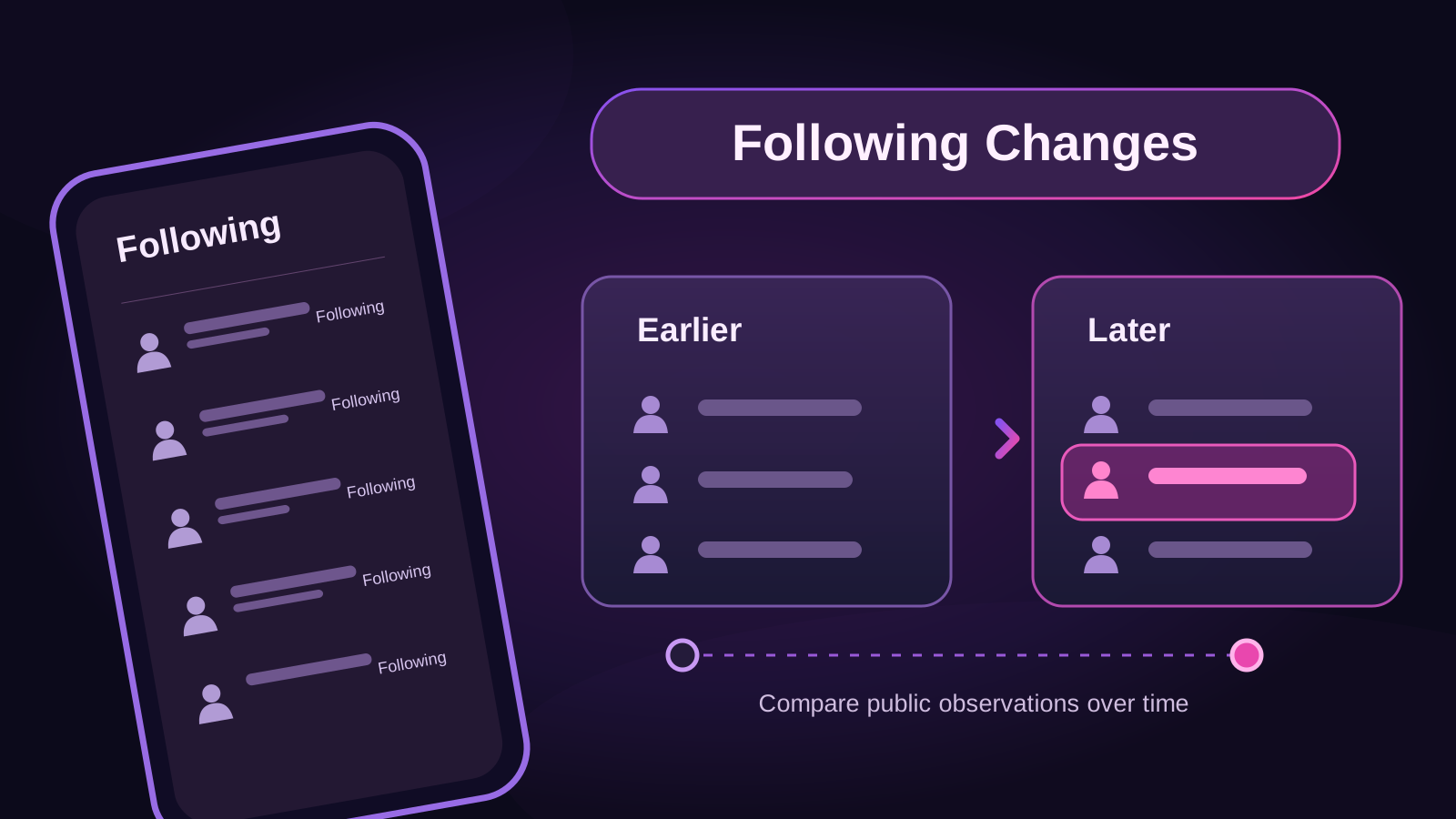
If an unfamiliar account suddenly appears near the top of a partner’s Following list, it is tempting to assume it was just followed. That is not a sound conclusion. A reordered list, an incomplete earlier snapshot, or changes in public-data availability can make an older connection appear new. What matters is whether there is a trustworthy observation made before and after the change.
What changed in September 2026? The short answer
In September 2026, third-party tracking providers including IGDetective and DolphinRadar reported changes in the order or delivery of Instagram follower and Following lists. Several dated accounts identify September 9 as the turning point. We have not located an official Instagram announcement confirming that exact date, so it should be treated as a widely reported service-side change, not as an announced Meta release.
The important outcome is less controversial than the exact release date: looking at the first names in another person’s Following list does not reveal their newest follows. Even before September, the visible list was not a dependable chronological timeline. After the reported change, ranking and data delivery became an even weaker basis for guessing follow dates.
Is someone else’s Instagram Following list chronological?
No. The order of another account’s public Following list should not be read as newest-to-oldest. A name can move upward without a new follow, and two visits can display a different order. Mutual follows, relevance, and other ranking explanations are common theories, but Instagram has not published a definitive formula for this list.
Your own account is different: Instagram may offer a Date followed sorting option for the accounts you follow. That control does not give you a chronological view of someone else’s follow history. A screenshot of another account’s list is a snapshot of what is displayed, not a timestamped event log.
Can you still see who someone recently followed?
You can sometimes identify accounts observed in a public profile’s Following list after tracking began. This requires comparing observations from different times rather than guessing from a list’s position. The first observation establishes a baseline; a later observation may reveal names absent from the earlier one.
A detected appearance is not necessarily proof that the follow happened between those checks. The earlier result could have been partial, a profile could have changed visibility, or the service may have gained access to more data. This distinction applies to any tracker that analyzes public information.
Baseline vs. newly observed: how to read the dates
Baseline means the publicly available Following information recorded when monitoring starts. It cannot reconstruct the order in which every existing follow happened beforehand. If an account appears in that first saved list, you cannot infer it was followed yesterday simply because it is near the top.
First seen or detected at means when a monitoring service first recorded a particular account in its available observations. It is not the exact Instagram follow timestamp. Weekly report dates identify the observation window or report interval; they should not be presented as the moment Instagram recorded a follow.
For example, if a profile is checked on November 2 and November 9, a name that appears only on November 9 is newly observed in that comparison. It may represent a new follow, but you still need data coverage and context before calling it a verified new connection.
How to check public Following changes after September 2026
**Step 1 — Confirm public visibility.** Check the account is public and its information is accessible. No legitimate public-data tool can bypass a private profile or recover private messages.
**Step 2 — Establish a starting point.** Save the first available Following observation as a baseline, including the date and any coverage limitations. Do not label the highest-ranked account as the newest follow.
**Step 3 — Compare later observations.** Review changes across future checks. Look for entries newly detected since the baseline, and keep the observation dates distinct from inferred follow dates.
**Step 4 — Check completeness.** A partial list, API interruption, or profile availability change can create false positives or missed accounts. Treat an empty update as no new account detected, not proof that nothing happened.
**Step 5 — Read the wider pattern.** A new public follow is one observation. If you are evaluating a relationship concern, consider repeatable public interactions and ordinary explanations rather than assigning a motive to a single account.
What a Weekly Following report can—and cannot—tell you
SocialSleuth organizes public Instagram signals and compares available observations over time. Its baseline and Weekly monitoring reports can help you review following changes alongside relevant public likes, comments, and other observable interaction patterns where data is available.
SocialSleuth does not promise a complete historical Following timeline, an exact Instagram follow timestamp, access to private accounts, direct messages, or every possible follow event. The usefulness of any comparison depends on the completeness of the available observations and the reporting interval.
Why an old follow might suddenly appear in a tracker
One possibility is a genuinely new follow. Others include pagination limits, temporarily unavailable results, reordered lists, intermittent access to public data, and differences between two snapshots. None of those alternatives can be dismissed using list position alone.
A careful report should label the result as newly observed when it cannot independently verify when the follow occurred. That wording protects you from treating routine platform changes as proof of unusual behavior.
The bottom line: compare observations, not list positions
The September 2026 reports reinforce a rule that is useful year-round: Instagram Following order is not a clock. The reliable question is not “Who is first in the list?” but “What was observable before, what is observable now, and how complete are those observations?”
For a broader explanation of ranking and list order, see the related guide on Instagram Following order. If you want to follow publicly available changes over time, explore SocialSleuth’s Instagram Following Tracker. Interpret each observation cautiously and never treat a follow alone as proof of a private relationship.
Did Instagram officially announce a Following list update on September 9, 2026?
Several third-party tracking services reported a change around that date, but we have not identified a public Meta announcement confirming the exact timing. The date should be attributed to those reports.
Does the first account in someone’s Following list mean it is their latest follow?
No. Another person’s Following list is not a reliable newest-first timeline.
Can I sort another person’s Instagram Following list by date?
Instagram’s Date followed option, when available, concerns your own Following list—not a chronological history of another account.
Can a tracker show the exact time someone followed a person?
Do not assume so. A first-seen or Weekly report timestamp usually describes when a service observed the account, not Instagram’s original follow time.
Does a newly detected account prove a new follow happened?
Not by itself. A prior incomplete observation or data-access change can cause an older follow to appear later.
Can SocialSleuth inspect private Following lists or DMs?
No. SocialSleuth uses public data and does not bypass Instagram privacy controls or read direct messages.